Defining the Superchain Thesis
The superchain thesis moves beyond the isolated scaling of individual Layer 2 networks. Instead of treating each chain as a standalone silo, the thesis proposes a modular architecture where multiple Layer 2s and Layer 3s operate as a unified ecosystem. This structure relies on the OP Stack, a shared codebase that standardizes the underlying infrastructure, allowing distinct chains to interoperate with minimal friction.
At its core, the superchain is a network of chains that share bridging, governance, upgrades, and a communication layer. By standardizing these components, operators can deploy new chains rapidly while inheriting security and liquidity from the broader network. This approach contrasts with generic L2 scaling, which often requires each project to build its own cross-chain messaging and security models from scratch.
The economic reality of this model is visible in the integration of major protocols. For instance, Uniswap’s deployment on OP Stack chains demonstrates how liquidity can flow seamlessly across the network without requiring users to navigate complex, fragmented bridges. Similarly, Base operates as a primary node in this ecosystem, leveraging the shared security model to maintain low fees while benefiting from the trust and liquidity established by the wider Optimism Collective.
This technical convergence reduces the "fragmentation tax" that has historically plagued Ethereum scaling. When chains share a common set of rules and communication protocols, the cost of interoperability drops significantly. The result is a modular scaling solution where the whole is more efficient than the sum of its parts, offering a sustainable path for high-throughput applications without compromising on decentralization.
Layer 3 scaling mechanics
Layer 3s function as specialized execution environments within the superchain architecture, designed to offload specific workloads from Layer 2 sequencers. By treating L2s as data availability (DA) layers, L3s achieve true modular scaling. This separation allows L3s to customize their execution logic—such as gas tokenization or privacy features—without compromising the security or throughput of the underlying L2.
In this model, the L2 acts as a shared settlement and DA layer. L3s post their compressed transaction data to the L2, paying fees in the L2’s native currency. This creates a nested hierarchy where the L2 provides economic security, while the L3 handles high-frequency execution. For example, a gaming L3 on Base can process thousands of transactions per second, submitting only the final state roots to the Base sequencer.
This architecture reduces the computational burden on L2s like Base or Uniswap’s OP Stack deployments. Instead of processing every individual transaction, L2s verify the validity proofs or fraud proofs submitted by L3s. This efficiency allows the superchain to scale horizontally, adding new L3s as demand increases without congesting the primary L2 network.
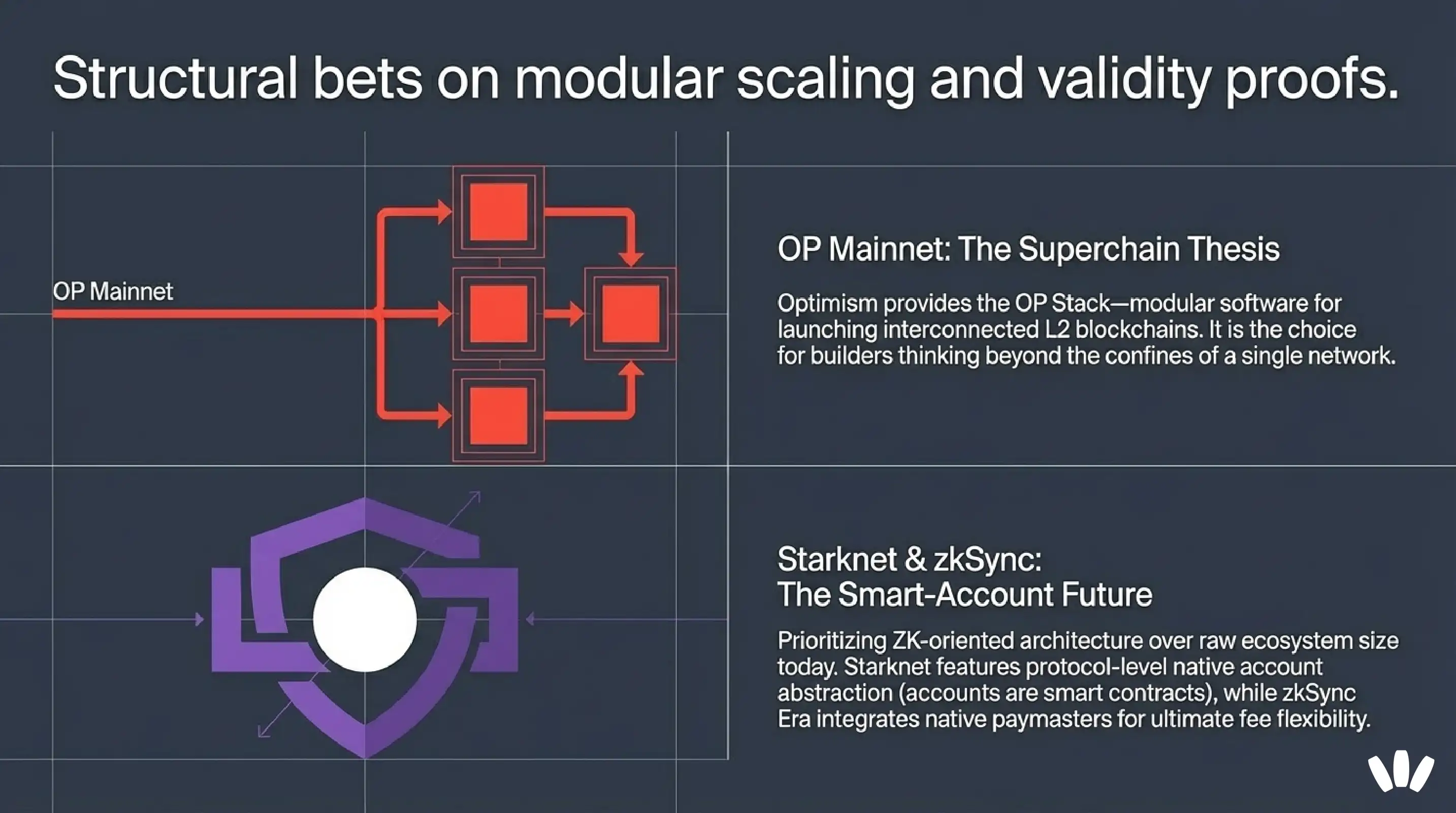
The economic implications are significant. L3 operators pay a fixed fee to the L2 for data availability, which can be substantially lower than the cost of posting directly to Ethereum L1. This cost structure enables new business models, such as zero-fee gaming or private transactions, which would be economically unviable on a monolithic chain. The superchain thesis thus redefines scaling not as a single chain’s performance, but as a network of specialized chains sharing a common security layer.
Market dynamics and tokenomics
The financial architecture of the superchain thesis is undergoing a rigorous stress test. At the center of this analysis is the OP token, which serves as the governance and utility backbone for the Optimism Collective. Its market performance is no longer just a reflection of the token itself but acts as a barometer for the entire modular scaling narrative. Recent volatility has forced the market to reassess the relationship between shared security and independent economic incentives.
The recent price action underscores the stakes. As noted by market analysts, the sharp decline in OP’s value—dropping to approximately $0.14—represents a broader market repricing of the superchain thesis. This correction highlights the tension between the theoretical benefits of a unified ecosystem and the practical realities of revenue distribution. If flagship chains like Base, which powers a significant portion of OP Stack activity, shift their economic alignment, the value accrual model for OP holders faces existential questions.
To understand these dynamics, it is useful to compare the economic structures of OP Stack L2s against independent L2s. The following table outlines the key differences in fees, security, and interoperability that drive these market valuations.
| Feature | OP Stack L2 | Independent L2 |
|---|---|---|
| Security Model | Shared sequencer & state commitments | Proprietary or rollup-as-a-service |
| Interoperability | Native via OP Stack messaging | Dependent on bridges or IBC |
| Revenue Share | Tied to Optimism Collective grants | Captured by issuing protocol |
| Governance | OP token holder voting | Protocol-specific DAO or foundation |
The market is currently pricing in the uncertainty of revenue sharing models. For the superchain to sustain its valuation, the economic benefits of network effects must flow back to the core governance token. Without clear mechanisms for value capture from high-activity chains like Base, the token’s utility remains speculative rather than structural.
Interoperability and cross-chain messaging
The superchain thesis relies on a shared communication layer that allows distinct Layer 3s to interact as a single logical network. This architecture moves beyond simple asset transfers, enabling the secure movement of arbitrary data and state between chains built on the OP Stack. By standardizing how chains speak to one another, the ecosystem reduces the fragmentation that typically plagues modular scaling solutions.
At the core of this infrastructure is the Superchain Bridge, which facilitates native token transfers with minimal friction. Unlike traditional cross-chain bridges that require complex liquidity pools and external validators, the superchain model leverages a centralized sequencer hierarchy for finality. This design choice significantly lowers transaction costs and latency, allowing applications like Base or Uniswap deployments to operate seamlessly across multiple chains without users managing disparate liquidity positions.
Beyond native assets, the ecosystem utilizes standardized messaging protocols to enable complex cross-chain interactions. These protocols allow smart contracts on one chain to trigger actions on another, supporting use cases such as cross-chain lending, unified liquidity aggregation, and synchronized governance. The technical reality is that this interoperability is not an afterthought but a foundational element of the OP Stack, ensuring that scalability does not come at the cost of composability.
| Feature | Traditional Bridges | Superchain Messaging |
|---|---|---|
| Finality Model | External Validators | Shared Sequencer |
| Liquidity | Fragmented Pools | Unified State |
| Cost | High Gas | Minimal |
Risks and the Anti-Superchain View
The Superchain thesis relies on a delicate balance of shared security and unified liquidity, but this structure introduces significant single points of failure. The model assumes that major Layer-3 chains, particularly flagship implementations like Base, will remain tethered to the Optimism Collective’s governance and technical standards. When these chains begin to diverge, the economic assumptions underpinning the entire ecosystem face immediate stress.
Centralization concerns are not merely theoretical; they are reflected in market behavior. The ~26% crash in the OP token, which fell to around $0.14, was widely interpreted by analysts as the market repricing the Superchain thesis itself. This volatility signals that investors view the cohesion of the OP Stack ecosystem as fragile. If Coinbase’s Base, the most prominent user of the OP Stack, decouples from the collective’s governance or shifts its technical roadmap, the unified liquidity thesis may fracture. This dependency creates a systemic risk where the health of dozens of L3s is disproportionately tied to the stability of a single governance body.
The "anti-superchain" argument, articulated by industry voices such as Cooper Kunz of Aztec Labs, suggests that this forced standardization stifles innovation. By prioritizing a monolithic stack, the ecosystem risks ignoring the distinct economic and security needs of individual L3s. As major players seek autonomy to optimize for their specific use cases, the potential for fragmentation increases. This divergence could lead to a fragmented landscape where shared security becomes a liability rather than an asset, forcing L3s to rebuild trust assumptions from scratch.
Key risk: If flagship chains like Base decouple from the OP Stack governance, the unified liquidity thesis may fracture.
The technical reality is that maintaining a cohesive Superchain requires constant alignment. As L3s grow, their incentives will inevitably diverge from the collective’s broader goals. Without a mechanism to accommodate this divergence without breaking the chain, the Superchain model may struggle to scale beyond its current early-adopter phase. The coming year will likely test whether the OP Stack can evolve into a more federated model or if it will remain vulnerable to the centrifugal forces of its own success.
Frequently asked questions about the superchain thesis
The superchain thesis describes a modular scaling architecture where multiple Layer 2 chains share a common protocol stack and security model. This approach aims to reduce fragmentation and improve interoperability across the Ethereum ecosystem.
What exactly is the superchain?
The superchain is not a single blockchain but a network of Layer 2 rollups built with the OP Stack. These chains share critical infrastructure, including bridging, governance mechanisms, and upgrade protocols. By standardizing the underlying code, the superchain allows chains like Base to launch with proven security and seamless cross-chain communication. This modular design contrasts with monolithic chains, offering greater flexibility and reduced development overhead.
How does the OP token fit into this model?
The OP token serves as the governance asset for the Optimism Collective, which oversees the superchain's evolution. It does not directly secure individual Layer 3s or pay for gas on every chain in the network. Instead, OP holders vote on protocol upgrades and the distribution of the Retroactive Public Goods Funding (RPGF) program. This governance structure aligns incentives between the core protocol and the diverse applications built on top of it, ensuring that economic benefits flow back to the ecosystem's contributors.
Why are Layer 3s critical to the thesis?
Layer 3s act as specialized execution layers that sit on top of Layer 2s, allowing for extreme customization without compromising the base security of the underlying chain. For example, a gaming app might use a Layer 3 to achieve sub-second finality, while a DeFi protocol uses another for high-throughput trading. This hierarchy enables the superchain to scale vertically, handling millions of transactions across specialized use cases while maintaining a unified security and communication layer.
No comments yet. Be the first to share your thoughts!