Defining the superchain thesis
The superchain thesis represents a structural shift in Ethereum scaling, moving beyond isolated Layer 2 deployments toward a unified ecosystem. It is defined as a network of Layer 2 blockchains that anchor their security to Ethereum L1 and utilize a native, standardized cross-chain messaging layer. This architecture, primarily driven by the OP Stack, aims to solve the fragmentation issues inherent in earlier multi-chain models by ensuring interoperability and shared security guarantees across connected chains.
Unlike generic multi-chain narratives where assets must traverse complex, trust-heavy bridges, the superchain model embeds interoperability into the protocol level. The OP Stack provides the modular software components necessary for this cohesion, including the execution layer and the cross-L2 message passing system. This allows distinct chains, such as Base and Optimism, to operate as part of a single logical unit rather than disconnected silos. Users can interact with applications across these chains without manual bridging, as the messaging layer handles state synchronization automatically.
The economic and structural implications are significant. By standardizing the underlying infrastructure, the superchain thesis reduces the overhead for new chain deployments and enhances the security posture of the entire network. Since all participating chains inherit security from Ethereum, the attack surface is minimized compared to independent L1s with their own validator sets. This approach prioritizes composability and user experience, allowing developers to build once and deploy across the superchain, while users enjoy seamless transitions between different L2 environments.
How the OP Stack Enables Modular Scaling
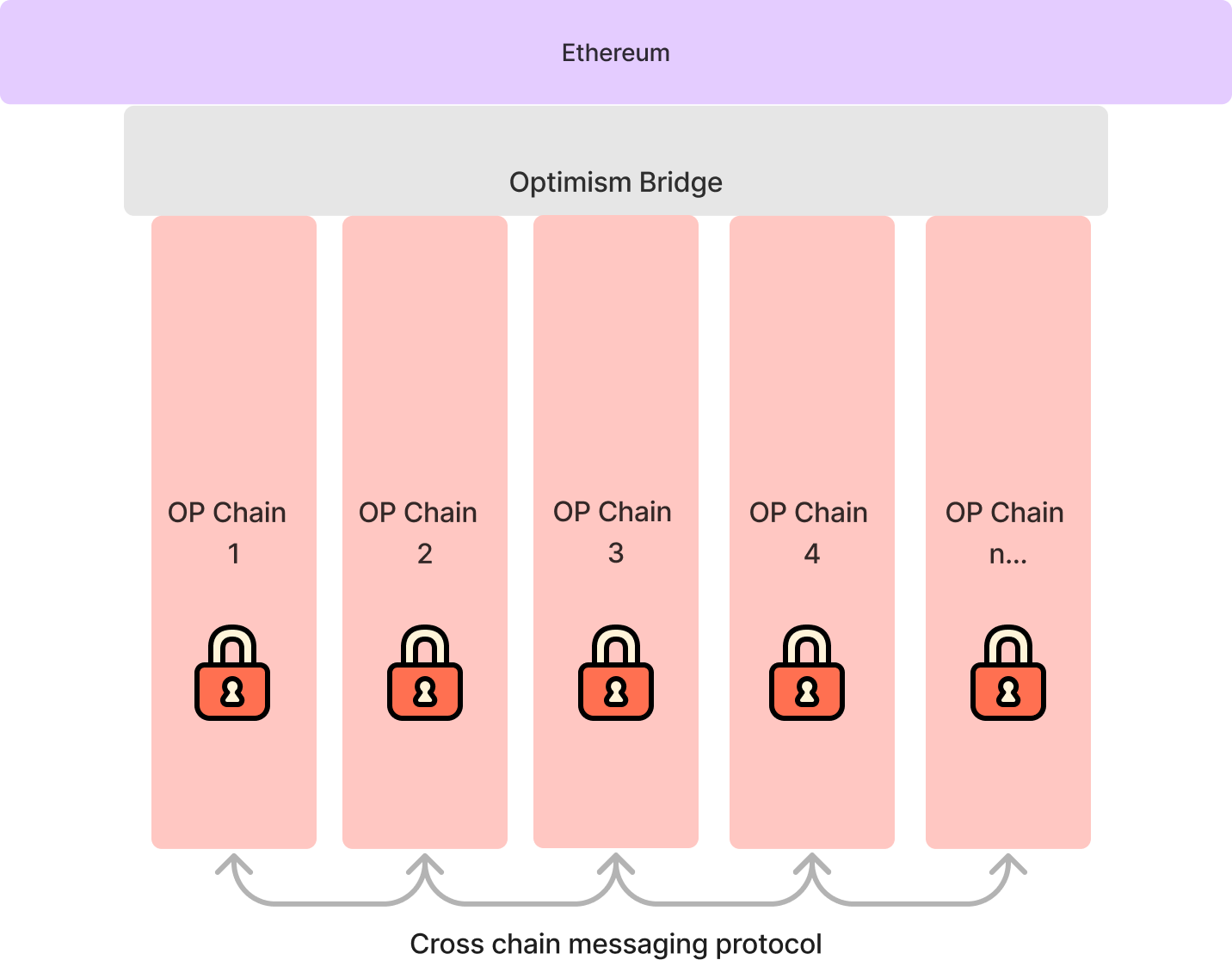
The OP Stack serves as the foundational software suite that allows multiple blockchains to interoperate as a single, cohesive network known as the Superchain. Rather than building isolated Layer 2 networks, developers use this modular collection of components to launch chains that anchor their security to Ethereum’s Layer 1. This architecture transforms the traditional view of scalability from a singular bottleneck into a distributed system where execution, batching, and proving layers operate in concert.
At the core of this structure is the separation of concerns. The execution layer processes transactions off-chain, while the batching and proposing layers handle the secure settlement of state roots back to Ethereum. This modularity is not merely a technical preference but an economic imperative. By standardizing the underlying codebase, the OP Stack reduces the friction of launching new chains and ensures that they inherit the same robust security guarantees as their peers. Networks like Base and Optimism demonstrate how this shared infrastructure creates a unified ecosystem where liquidity and messaging can flow freely across different chains.
The implications for market analysis are significant. When execution and security are decoupled, the cost of launching new financial primitives drops dramatically, encouraging rapid innovation while maintaining the integrity of the underlying asset. This structural shift moves Ethereum from a monolithic platform to a modular network of specialized chains. Understanding this mechanism is essential for evaluating the long-term viability of Layer 2 solutions, as it highlights how shared security reduces fragmentation and enhances the overall utility of the Ethereum ecosystem.
Cross-chain liquidity and user experience
The primary economic friction in the current multi-chain environment is the fragmentation of liquidity and the high cost of asset movement. Traditional cross-chain bridges require users to lock assets on a source chain and mint wrapped representations on a destination chain. This process introduces significant latency, counterparty risk, and transaction fees that scale poorly with volume. The Superchain thesis addresses these structural inefficiencies by treating the network as a unified system rather than a collection of isolated silos.
By leveraging the OP Stack and native messaging protocols, chains within the Superchain architecture share a common security and communication layer. This reduces the reliance on third-party bridge contracts, which have historically been the most vulnerable attack surface in decentralized finance. Instead of moving assets across disparate networks, liquidity remains anchored in a shared state, allowing for near-instant finality and lower gas costs. This structural shift transforms cross-chain interaction from a complex, error-prone operation into a seamless background process.
The following comparison illustrates the operational differences between traditional bridging mechanisms and Superchain-native messaging. The data highlights the reduction in risk exposure and cost efficiency that native interoperability provides.
| Feature | Traditional Bridge | Superchain Native | Impact |
|---|---|---|---|
| Settlement Time | Minutes to Hours | Seconds | Improved UX |
| Security Model | External Validator Set | Shared Sequencer/Verifier | Reduced Risk |
| Gas Costs | High (Dual Fees) | Low (Single Fee) | Cost Efficiency |
| Liquidity Fragmentation | High | Minimal | Capital Efficiency |
| User Abstraction | Manual Wrapping | Native Transfers | Simplified Flow |
This architectural alignment allows developers to build applications that do not need to account for cross-chain latency or bridge solvency. Users interact with a single interface, while the underlying infrastructure handles the routing and settlement. This mirrors the evolution of traditional banking, where internal transfers are instant and free, while international wire transfers incur fees and delays. The Superchain aims to make internal transfers the default, relegating external, high-friction bridges to legacy status.
Market adoption and ecosystem trends
The Superchain thesis has moved from theoretical architecture to tangible market dynamics, with Optimism and Coinbase's Base serving as the primary case studies for modular scaling. This shift is not merely technical; it redefines how value accrues within the Ethereum ecosystem. By standardizing the OP Stack, these networks are attempting to solve the fragmentation problem that has historically limited Ethereum's ability to scale while maintaining security.
Optimism has positioned itself as the backbone of this model, offering a shared sequencer and settlement layer that reduces costs for downstream chains. However, the economic implications of this shared infrastructure are now under scrutiny. As the ecosystem grows, the question of revenue distribution and governance control has become central to the thesis's viability.
The relationship between major players like Base and Optimism highlights the fragility of the superchain model. Base, initially built on the OP Stack, has recently signaled a strategic pivot away from Optimism's centralized sequencer. This move raises critical questions about the sustainability of shared revenue models and the long-term cohesion of the superchain. If key participants decouple from the shared infrastructure, the economic incentives that drive adoption may weaken.
This tension between standardization and independence defines the current market landscape. The superchain thesis relies on a delicate balance: enough centralization to achieve scale and security, but enough decentralization to maintain trust. As Base and others explore alternative architectures, the future of the superchain will depend on whether the economic benefits of shared infrastructure outweigh the desire for operational autonomy.
Risks and centralization concerns
The superchain thesis faces structural headwinds that challenge its long-term viability. The most immediate threat is governance centralization. Because the OP Stack is maintained by a small core team at Optimism, the protocol lacks the decentralized decision-making processes that characterize mature Ethereum infrastructure. This creates a single point of failure; if the core team diverges from community expectations, the entire superchain ecosystem faces regulatory and operational uncertainty.
Fragmentation presents a second critical risk. The superchain model relies on shared liquidity and standardized security. However, as major chains like Base grow, their economic incentives may diverge from the Optimism Collective. Base’s recent shift toward independent governance structures signals a potential break from the unified superchain revenue-sharing model. If leading chains opt out, the network effect weakens, and the shared security pool fragments.
This tension between modular efficiency and decentralized governance remains unresolved. The superchain’s success depends on whether individual chains can align their economic interests with the broader ecosystem. Without a robust, decentralized governance framework, the superchain risks becoming a collection of siloed networks rather than a unified scaling solution.
No comments yet. Be the first to share your thoughts!