Defining the superchain thesis
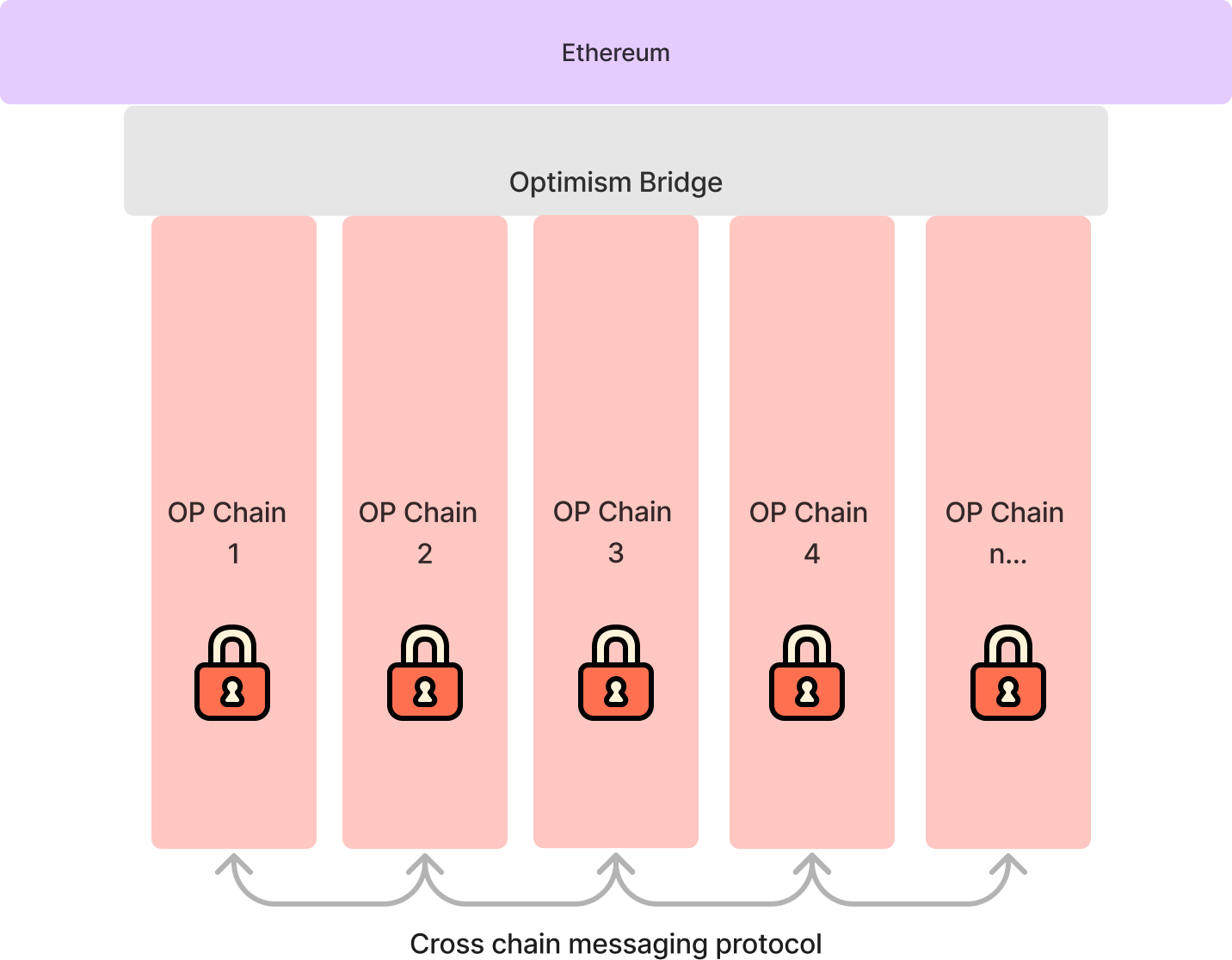
The superchain thesis moves beyond the fragmented multi-chain narrative by introducing a standardized, modular architecture anchored to Ethereum. Rather than treating Layer 2s as isolated silos, this model envisions a network of chains that share a common security layer and native cross-chain messaging infrastructure. The core innovation lies in the OP Stack, which provides a uniform blueprint for building and operating these networks.
At its technical heart, the superchain is a collection of OP Stack-based chains that rely on Ethereum as their primary security anchor. This structure eliminates the need for complex, trust-minimized bridges between disparate networks. Instead, chains within the ecosystem communicate through a native messaging layer, allowing for seamless asset transfers and state synchronization. This standardization reduces development overhead and enhances interoperability, creating a cohesive environment rather than a disjointed collection of independent protocols.
The economic implications of this thesis are significant. By sharing a single L1 security model, individual chains benefit from Ethereum’s robust decentralization without bearing the full cost of securing their own validator sets. This modular approach allows for specialized execution environments while maintaining a unified security guarantee. The result is a scalable ecosystem where innovation can occur at the execution layer, supported by a stable, shared foundation.
Market Impact of OP Stack Adoption
The technical architecture of the OP Stack has immediate financial consequences, primarily through its influence on the OP token and broader market valuation. As the foundational layer for the Superchain thesis, the widespread adoption of OP Stack by major chains like Base directly impacts the economic incentives and utility of the native OP token. This relationship creates a feedback loop where network growth must translate into tangible value accrual to sustain investor confidence.
Market participants are increasingly viewing the OP token not just as a governance instrument, but as a proxy for the health of the modular L2 ecosystem. When flagship chains signal a shift in alignment or utility, the market responds swiftly. Recent volatility has reflected this sensitivity, with significant price drops occurring alongside news of strategic decoupling from the core Optimism ecosystem. This repricing event highlights how deeply the market has integrated the Superchain thesis into its valuation models.
The integration of live market data reveals the real-time nature of this valuation. Traders monitor the OP/USD pair closely to gauge sentiment regarding the Superchain's future. A decline in price often signals concerns about tokenomics sustainability or reduced demand for the underlying infrastructure. Conversely, steady growth suggests that the technical benefits of modular L2s are being recognized as economically viable.
Understanding these market dynamics is essential for analyzing the long-term viability of the Superchain thesis. The correlation between OP Stack adoption and token performance underscores the importance of aligning technical innovation with sustainable economic models. As the ecosystem matures, the ability to demonstrate clear value accrual will likely determine which projects thrive and which struggle to maintain relevance.
Base and the fragmentation risk
The Superchain thesis relies on a delicate balance: a shared security model and standardized execution environment that allows distinct chains to operate as a unified network. Base, built on the OP Stack, was designed to be the flagship example of this model. Its rapid growth in total value locked and daily active users demonstrated the viability of modular scaling. However, this success has introduced a structural tension between centralized execution and decentralized governance.
As Base expands, its operational needs increasingly diverge from the broader Optimism Collective. The network’s scale requires infrastructure and governance decisions that prioritize its specific economic incentives over the collective good of the superchain. This creates a fragmentation risk where the flagship chain effectively operates as a sovereign entity within the ecosystem, undermining the interoperability and shared security that define the thesis.
Market signals reflect this growing anxiety. The price of OP token, which represents governance rights over the collective, has experienced significant volatility, with recent drops around 26% attributed to investors repricing the long-term viability of the superchain model. If the flagship chain decouples from the governance framework, the economic value of the collective token may not capture the growth generated by its largest component.
This dynamic challenges the core premise that modular L2s can scale without sacrificing decentralization. When the most successful chain prioritizes its own trajectory, the network effect weakens. The superchain risks becoming a loose collection of independent L2s rather than a cohesive, secure, and interoperable ecosystem.
Comparing modular L2 architectures
The modular L2 landscape is no longer monolithic. While the superchain model, anchored by the OP Stack, prioritizes shared security and cross-chain messaging, other architectures like ZK-Rollups and independent L2s offer different trade-offs regarding finality and interoperability.
The following comparison outlines how these models diverge in security assumptions, transaction speed, and cross-chain connectivity.
| Architecture | Security Model | Finality | Interoperability |
|---|---|---|---|
| Superchain (OP Stack) | Shared L1 Security (Ethereum) | ~10-30 minutes (L1 finality) | Native (Cross-Chain Messaging) |
| ZK-Rollups | Cryptographic Proof (ZK-SNARKs) | ~15-20 minutes (Proof verification) | Limited (Bridges) |
| Independent L2s | Own Sequencer/Validator Set | Seconds (L2 native) | Limited (Bridges) |
The superchain model’s primary advantage lies in its native interoperability. By sharing a common execution layer and security anchor, chains within the ecosystem can communicate without relying on external, often risky, bridges. In contrast, ZK-Rollups and independent L2s typically require cross-chain bridges to facilitate asset transfers, introducing additional trust assumptions and potential attack vectors.
Viability Concerns
Investors often question whether the OP token captures sufficient value from the ecosystem's growth. The token's utility is primarily tied to governance and fee discounts, which may not align with long-term value accrual if transaction fees remain low.
Regulatory scrutiny poses another risk. As the superchain scales, the decentralized nature of its sequencers and validators could attract attention from securities regulators, particularly regarding the classification of the OP token.
Security remains paramount. While the superchain model improves interoperability, it also expands the attack surface. Any vulnerability in the shared sequencer infrastructure or cross-chain messaging protocols could impact all connected chains.
No comments yet. Be the first to share your thoughts!