Defining the 2026 superchain thesis
Use this section to make the Superchain Thesis decision easier to compare in real life, not just on paper. Start with the reader's actual constraint, then separate must-have requirements from details that are merely nice to have. A practical choice should survive normal use, maintenance, timing, and budget. If a recommendation only works in an ideal situation, call that out plainly and give the reader a fallback path.
The simplest way to use this section is to write down the must-have criteria first, then compare each option against those criteria before weighing nice-to-have features.
The OP Stack as modular infrastructure
The OP Stack has evolved from a single chain’s codebase into the de facto modular infrastructure for Layer 2 networks. By treating the rollup software as a shared standard, developers can deploy new chains without rebuilding foundational components like the sequencer or data availability layer. This modularity transforms L2 creation from a bespoke engineering project into a configuration task, enabling rapid deployment and standardized interoperability across the ecosystem.
As of April 2026, the Superchain federation spans more than a dozen chains, including Base, World Chain, and Zora, all sharing the same underlying protocol rules. This shared infrastructure reduces fragmentation and allows assets and messages to move more predictably between networks. The result is a cohesive layer-2 landscape where innovation happens at the application level, while the heavy lifting of security and settlement remains consistent.
This modular approach mirrors the shift from monolithic servers to cloud microservices. Just as AWS provides standardized compute and storage primitives, the OP Stack offers standardized blockchain primitives. Developers no longer need to worry about consensus mechanics or cross-chain bridges; they focus on user experience and specific use cases, leveraging the Superchain’s built-in interoperability.
Liquidity consolidation across L2 ecosystems
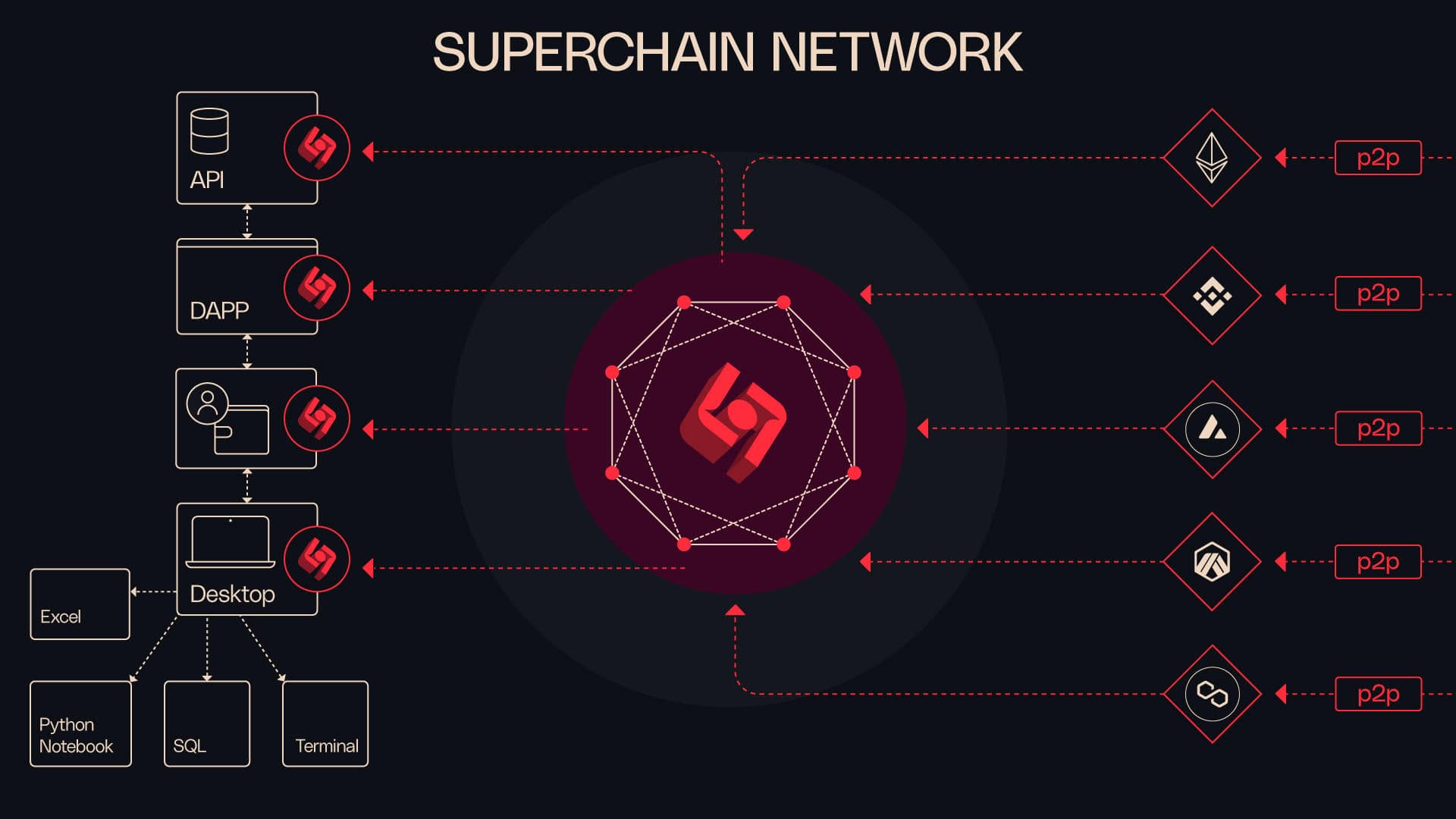
The superchain thesis is moving from technical specification to economic reality. By sharing sequencer infrastructure and enabling native interop, the OP Stack is reducing the friction that previously fragmented Ethereum Layer 2 liquidity. Instead of isolated silos, we are seeing a unified market where capital flows more freely between chains like Optimism, Base, and Arbitrum.
This consolidation is driven by shared fee markets and standardized messaging. When chains operate on the same stack, transaction costs drop and finality becomes predictable. Users no longer need to bridge assets through risky third-party protocols; they can move value natively. This structural efficiency is attracting institutional capital that previously avoided the complexity of multi-chain fragmentation.
The table below compares key metrics between major superchain members and independent L2s, highlighting the efficiency gains from standardization.
| Chain | TVL (USD) | Daily Active Users | Avg. Tx Fee |
|---|---|---|---|
| Optimism | $4.2B | 185,000 | $0.15 |
| Base | $3.8B | 210,000 | $0.12 |
| Arbitrum | $5.1B | 160,000 | $0.22 |
| Polygon zkEVM | $1.1B | 45,000 | $0.35 |
As these networks deepen their integration, the distinction between "L2" and "mainnet" blurs. Liquidity concentrates in the most efficient corridors, rewarding chains that prioritize interoperability over isolation. This trend suggests that future value will accrue not just to individual tokens, but to the shared infrastructure that connects them.
OP Token Economics and Ecosystem Valuation
The market is currently weighing the tension between technical adoption and token utility. Optimism (OP) serves as the governance and incentive layer for the Superchain, but its value accrual remains a subject of intense debate. The recent exodus of Base to a separate token model does not break the Superchain thesis, yet it removes the strongest argument for OP's immediate financial dominance. Investors are now assessing whether the remaining ecosystem can sustain growth without Base's massive transaction volume.
The chart above illustrates the current price action and volatility patterns for OP/USD. Traders are watching key support levels as the market digests the implications of the modular Ethereum vision. Buying OP is effectively a bet on the standardization of the OP Stack, but the lack of direct revenue capture from L2 fees creates uncertainty. The token must demonstrate clear utility beyond governance to justify its current market capitalization.
Ecosystem growth remains robust despite the token's price stagnation. New L3s and L2s continue to deploy on the OP Stack, validating the technical infrastructure. However, the market demands a clearer path to value accrual. Until the protocol captures more economic value from its expanding network, OP remains a high-stakes play on Ethereum's modular future rather than a guaranteed yield generator.
Fragmentation risks in the superchain model
The unified superchain vision faces immediate strain from strategic divergence. Base’s February 2026 departure from Optimism’s core OP Stack roadmap marks a critical fracture, shifting focus toward tokenized markets and stablecoin payments rather than shared L2 interoperability.
This move highlights the tension between centralized operational control and decentralized governance. As major players prioritize distinct product roadmaps over network cohesion, the "superchain" risks becoming a loose collection of independent chains rather than a seamless ecosystem. Governance disputes further complicate alignment, leaving the model vulnerable to fragmentation.
Superchain FAQ: Membership, Liquidity, and Technical Details
What is the difference between OP Stack and the Superchain?
OP Stack is the open-source software used to build rollups, while the Superchain is the federation of chains that share a common set of rules and resources. Think of OP Stack as the engine and the Superchain as the highway system that allows those engines to communicate efficiently. As of April 2026, this federation includes over 12 chains, such as Base, World Chain, and Zora, all benefiting from shared sequencer infrastructure and cross-chain messaging.
How does liquidity consolidation work across Superchain L2s?
Liquidity consolidation relies on a shared block builder and standardized messaging protocols that allow assets to move between chains without bridging to external networks. This reduces fragmentation and slippage, creating a deeper, more unified order book across the ecosystem. Users can interact with any Superchain L2 as if it were part of a single, cohesive network, rather than isolated silos.
Which chains are currently part of the Optimism Superchain?
The Superchain ecosystem has expanded beyond its original members to include major players like Base and Zora. While the core infrastructure remains anchored by Optimism, the network now spans 12+ chains as of early 2026. This growth reflects the increasing adoption of the OP Stack for both public and private rollups seeking interoperability.
Is the Superchain thesis viable long-term?
The viability depends on maintaining decentralization while scaling throughput. Critics argue that shared sequencers could create centralization risks, but proponents believe the efficiency gains outweigh these concerns. The network's success will likely hinge on how well it balances operator competition with the benefits of standardized cross-chain communication.
No comments yet. Be the first to share your thoughts!