Defining the superchain thesis 2026
The superchain thesis redefines modular blockchain infrastructure by treating a group of L2s as a single, cohesive ecosystem rather than isolated silos. At its core, this model relies on the OP Stack, an open-source development framework that allows multiple chains to share critical components. Instead of each L2 building its own sequencer, DA layer, and security guarantees from scratch, they leverage a standardized stack to interact with Ethereum Mainnet. This structural shift moves the focus from chain competition to network interoperability.
In 2026, the primary value driver is shared security. By anchoring to Ethereum Mainnet through a unified bridge and consensus layer, L2s benefit from the same economic security without the overhead of independent validator sets. This creates a "moat" of efficiency: developers can deploy applications that move seamlessly across chains, while users experience unified liquidity and lower transaction costs. The technical reality is that the OP Stack acts as the common denominator, ensuring that state transitions are verified consistently across the network.
The expansion from a single chain to a dozen production networks demonstrates the viability of this model. As more chains adopt the same stack, the network effects compound. Liquidity fragments less because the underlying settlement layer remains consistent. For investors and developers, the superchain thesis is no longer just about scaling throughput; it is about creating a resilient, interconnected financial layer where interoperability is the default, not an afterthought.
OP Stack and shared security mechanics
The Superchain Thesis relies on a standardized technical foundation: the OP Stack. By decoupling the execution layer from the consensus and data availability layers, Optimism created a modular blueprint that allows multiple rollups to operate as a unified network. This architecture transforms isolated Layer 2 chains into a cohesive ecosystem where shared security and interoperability replace fragmented liquidity.
At the core of this model is the shared sequencer set. Instead of each rollup managing its own sequencing infrastructure, chains can share sequencer nodes. This reduces operational overhead and ensures that transaction ordering remains consistent across the network. The result is lower latency for cross-chain interactions and a more predictable user experience, which is critical for institutional adoption.
Shared state and native interoperability further deepen the network effect. Through the OP Stack, chains can execute cross-messages natively, allowing assets and data to move between L2s without relying on third-party bridges or wrapped tokens. This structural efficiency reduces counterparty risk and gas costs, creating a "moat" that makes the Superchain more attractive than standalone L2s. As of April 2026, this model has expanded from a single chain to a dozen production networks, demonstrating the scalability of the shared security model.
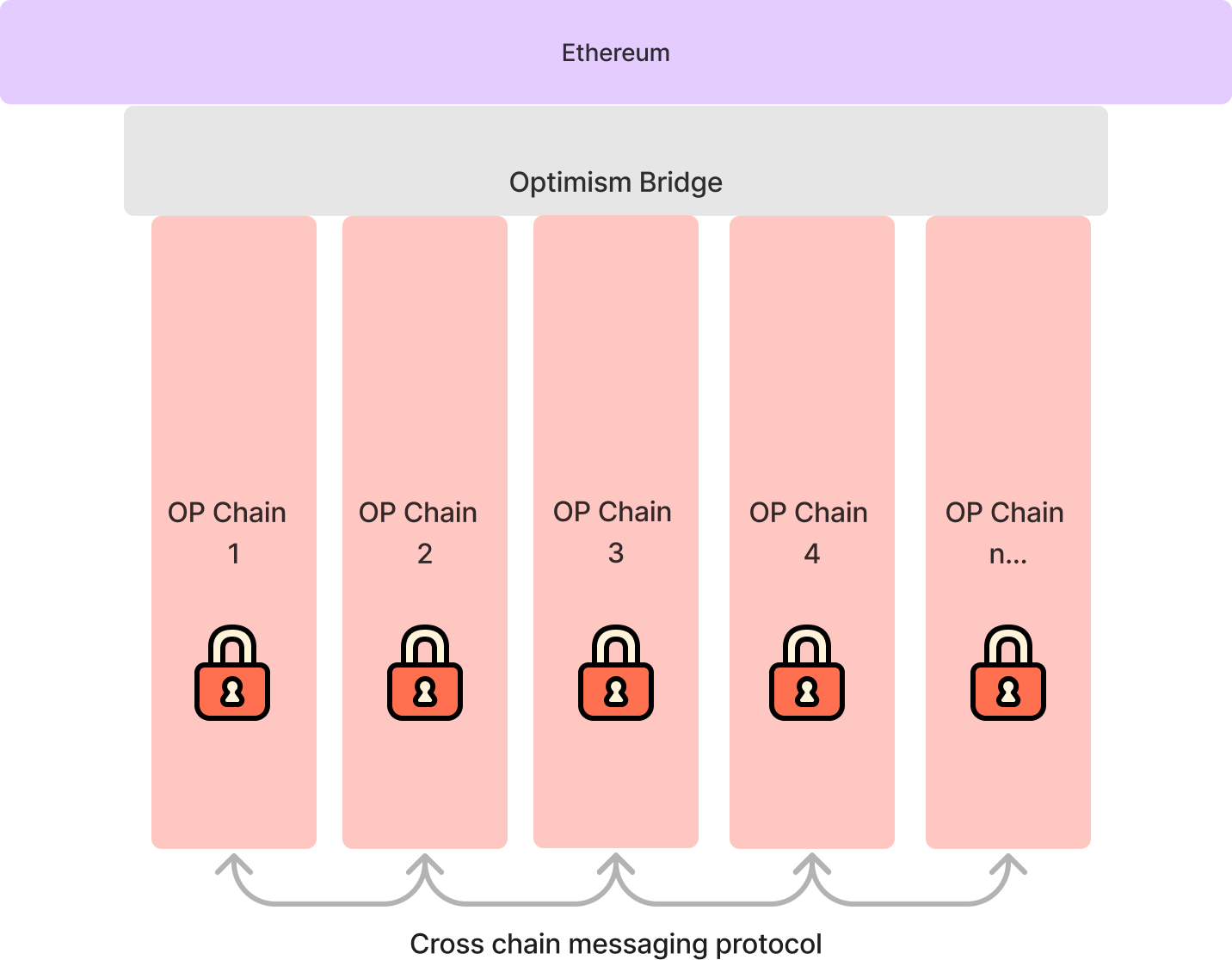
The economic implications are significant. By sharing security through the Optimism Collective’s fraud proof mechanism, new chains inherit the security budget of the entire network without needing to bootstrap their own validator sets. This lowers the barrier to entry for new projects while maintaining the integrity of the broader ecosystem. The Superchain is not just a technical upgrade; it is a structural shift in how Layer 2 scalability is delivered.
Cross-chain liquidity and native interop
Fragmentation is the structural liability of multi-chain ecosystems. When users move assets between chains, they traditionally rely on bridges—smart contract intermediaries that lock funds on one chain and mint wrapped versions on another. These bridges represent a significant attack surface. Their security is only as strong as their weakest validator or custodian, and historical failures have bled billions from the sector. This friction creates silos of liquidity that prevent capital from flowing efficiently across the network.
The Superchain thesis addresses this by embedding interoperability directly into the protocol layer. Instead of external bridges, chains built on the OP Stack share a common security layer and communication protocol. This native interop allows assets to move between chains with near-instant finality and minimal cost. The mechanism relies on a system of "messages" that are verified by the rollup's execution layer, removing the need for third-party custodians.
This architectural shift changes the economic calculus of liquidity. Capital is no longer trapped in isolated pools; it can flow to where yield is highest or where user activity is concentrated, without exposing the user to bridge-specific smart contract risk. For institutional participants, this reduces counterparty exposure and simplifies compliance audits. The liquidity landscape becomes a single, unified market rather than a collection of fragmented islands.
However, this model is not without its own structural tensions. The recent strategic divergence of Base from Optimism's core governance highlights the challenges of maintaining a unified protocol while allowing for independent economic roadmaps. As of early 2026, the Superchain has expanded to over a dozen production chains, yet the underlying interop mechanics remain a shared standard rather than a monolithic entity. The success of this model depends on whether the benefits of shared security outweigh the desire for chain-specific sovereignty.
| Feature | Traditional Bridges | Native Interop |
|---|---|---|
| Security Model | Third-party custodians or multi-sigs | Shared rollup security layer |
| Latency | Minutes to hours | Seconds to minutes |
| Liquidity Fragmentation | High (isolated pools) | Low (unified market) |
Base’s Departure and Thesis Resilience
Base’s strategic divergence in early 2026, particularly its move away from Optimism’s OP Stack, serves as the primary stress test for the Superchain thesis. This departure challenges the notion of a monolithic, unified modular ecosystem, forcing a re-evaluation of what constitutes a "moat" in a fragmented landscape.
The core tension lies between technical standardization and economic alignment. While Base’s focus on tokenized markets and stablecoin payments signals a pragmatic pivot toward high-volume utility, it fragments the underlying protocol layer. This does not invalidate the broader modular narrative, but it dismantles the strongest version of the Superchain argument: that a single, cohesive stack guarantees superior interoperability and user experience.
Structurally, the resilience of the thesis now depends on cross-chain composability rather than shared codebases. If Base and OP Mainnet can maintain seamless asset and data flow despite divergent stacks, the Superchain concept evolves from a technical standard to an economic protocol. If they cannot, the "Superchain" may simply become a brand name for loosely connected chains competing for the same liquidity.
The market’s reaction to this divergence provides the clearest signal. A continued premium on the OP token relative to other Layer 2s would suggest investors still value the broader ecosystem’s network effects, even without Base. Conversely, a stagnation in OP’s valuation would indicate that the market views Base’s exit as a critical failure of the unified thesis.
| Aspect | Unified Superchain | Fragmented Reality |
|---|---|---|
| Stack | Shared OP Stack | Divergent Stacks |
| Focus | General Purpose | Tokenized Markets |
| Moat | Technical Lock-in | Economic Alignment |
This shift forces builders to prioritize interoperability layers over native stack compatibility. The Superchain thesis survives not by enforcing uniformity, but by proving that diverse chains can operate as a single logical unit. The coming months will determine whether this is a viable architectural path or a temporary compromise.
Market outlook for Ethereum scaling
Use this section to make the Superchain Thesis decision easier to compare in real life, not just on paper. Start with the reader's actual constraint, then separate must-have requirements from details that are merely nice to have. A practical choice should survive normal use, maintenance, timing, and budget. If a recommendation only works in an ideal situation, call that out plainly and give the reader a fallback path.
The simplest way to use this section is to write down the must-have criteria first, then compare each option against those criteria before weighing nice-to-have features.
No comments yet. Be the first to share your thoughts!