Defining the superchain thesis 2026
The superchain thesis posits that multiple Layer 2 blockchains, built on shared standards like the OP Stack, will function as a single unified network rather than isolated silos. This architectural shift aims to solve the fragmentation that has historically plagued Ethereum scaling efforts, creating a cohesive ecosystem where liquidity and user experience flow seamlessly across different chains.
By standardizing the underlying technology, the superchain model allows distinct Layer 2s to share security assumptions and communication protocols. This means that assets and data can move between chains with minimal friction, effectively turning a collection of separate networks into one interconnected infrastructure. The goal is to eliminate the need for users to navigate complex bridges or manage disparate wallets across incompatible systems.
This structural evolution is central to the 2026 vision for Ethereum. As noted by LearnWeb3, the superchain concept relies on the interoperability of these L2s, ensuring that they operate under a common set of rules. This approach not only enhances scalability but also strengthens the network effect, making the entire ecosystem more robust and user-friendly.
The practical implications of this thesis are already visible. For instance, Optimism’s rebranding to OP Mainnet signals a strategic alignment with this broader superchain vision, emphasizing its role as a foundational block within a larger network of L2s. This move underscores the industry’s commitment to building a unified, rather than fragmented, scaling solution for Ethereum.
OP Stack vs ZK Stack architectures
The superchain thesis relies on modular blockchain design, primarily split between two competing architectural approaches: the OP Stack and ZK Stack. Both aim to scale Ethereum, but they solve the verification problem differently. Understanding these structural differences is essential for evaluating how liquidity and interoperability will flow across the network in 2026.
Optimistic Rollups and the OP Stack
Optimistic rollups, led by the OP Stack, assume transactions are valid by default. They post transaction data to Ethereum mainnet and rely on a "fraud proof" window—typically seven days—where anyone can challenge invalid states. This design prioritizes high throughput and compatibility with existing Ethereum Virtual Machine (EVM) code. Chains built on the OP Stack, such as Base and Optimism, benefit from immediate EVM equivalence, making deployment straightforward for developers already familiar with Ethereum tooling.
The superchain vision for OP Stack centers on modularity. By sharing a common sequencer and state output format, multiple OP Stack chains can operate as a unified network. This reduces redundancy and allows for faster finality within the local chain, though users must still wait for the fraud proof window to achieve full settlement on Ethereum. This approach favors developer adoption and ecosystem growth over immediate cryptographic certainty.
ZK Rollups and Cryptographic Verification
Zero-Knowledge (ZK) rollups take a different path by generating a "validity proof" for every batch of transactions. Instead of assuming validity, ZK rollups mathematically prove that the state transition is correct before posting it to Ethereum. This eliminates the fraud proof window, offering near-instant finality. However, generating these proofs requires significant computational resources, often leading to higher costs for transaction processing compared to optimistic approaches.
ZK stacks are currently working toward a unified superchain architecture. Projects like zkSync and Starknet are developing ZK-EVMs that maintain EVM compatibility while leveraging zero-knowledge cryptography. The goal is a network where multiple ZK chains can interoperate seamlessly, backed by a single, efficient proof system. This offers stronger security guarantees but presents a steeper technical barrier for developers migrating from standard EVM environments.
Structural Comparison
The choice between OP Stack and ZK Stack defines the trade-offs between speed, cost, and security. While OP Stack dominates current deployment volume due to its ease of use, ZK Stack offers superior settlement guarantees. The future superchain will likely involve a hybrid model, leveraging the strengths of both architectures.
| Feature | OP Stack (Optimistic) | ZK Stack (Validity) |
|---|---|---|
| Verification Method | Fraud Proofs (7-day window) | Validity Proofs (Instant) |
| EVM Compatibility | Full EVM Equivalence | EVM-like (ZK-EVM) |
| Settlement Finality | Delayed (Post-challenge) | Immediate on Ethereum |
| Development Complexity | Low (Standard EVM) | High (Proof Generation) |
| Primary Use Case | High-throughput consumer apps | High-security financial rails |
Unifying cross-chain liquidity
The Superchain thesis relies on the premise that shared sequencers and standardized protocols can eliminate the fragmentation that currently plagues Ethereum Layer 2 ecosystems. By treating multiple L2s as a single cohesive network rather than isolated silos, the architecture aims to reduce friction for liquidity providers and traders. This structural shift is not merely about convenience; it is about creating a unified order book experience across different chains, where capital flows freely without the latency and cost penalties of traditional bridges.
At the core of this unification is the standardization of transaction execution. When L2s share sequencer infrastructure, they align their block production and state transitions, allowing assets to move between chains with near-instant finality. This reduces the need for complex, trust-minimized bridges that often become attack vectors. Instead, liquidity can be pooled across the ecosystem, enhancing depth and reducing slippage for large trades. The result is a more efficient market where capital is not trapped in isolated pools but can be deployed where it is most needed.
Market sentiment reflects both the potential and the risks of this model. The recent volatility in the Optimism token (OP) has been interpreted by some analysts as a repricing of the Superchain thesis itself. As noted in market analysis, significant price drops can signal investor concerns about the long-term viability of shared infrastructure, particularly when major players like Base consider shifting their strategic focus. This highlights the delicate balance between standardization and the autonomy that individual L2 projects value.
The challenge for 2026 lies in maintaining this delicate equilibrium. While shared sequencers offer clear efficiency gains, they also create a central point of dependency. If the underlying standardization layer faces technical or governance issues, the entire ecosystem could be impacted. Therefore, the success of unified liquidity depends not just on technological implementation, but on the robustness of the governance frameworks that oversee these shared resources. The goal is a network that feels like one chain, while preserving the innovation and competition that drive the broader Ethereum ecosystem forward.
Market repricing and structural risks
The Superchain thesis is no longer a guaranteed trajectory; it is a competitive market outcome facing immediate structural headwinds. The most significant recent stress test comes from Coinbase’s Base, which has signaled a strategic shift away from its foundational reliance on the Optimism stack. This move fractures the assumption of universal alignment among major Layer 2 operators, suggesting that infrastructure dominance is not inevitable but must be continuously earned.
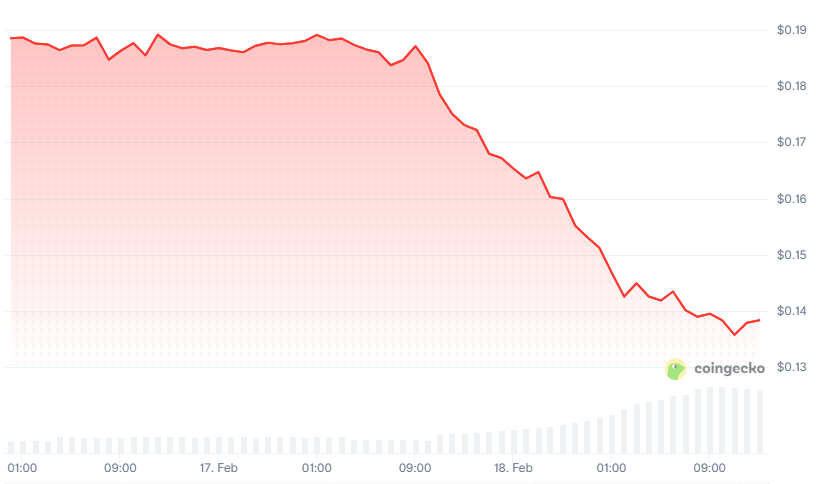
Market participants are already adjusting their valuations based on this fragmentation. As reported by The Defiant, the ~26% crash in the OP token price reflects a broader market repricing of the Superchain’s long-term viability. Investors are no longer betting on a monolithic ecosystem; they are discounting the probability that all major chains will remain interoperable under a single governance or technical framework.
The OP token price action illustrates this uncertainty clearly. The following chart visualizes the recent volatility and the downward pressure on the asset as the thesis faces scrutiny.
This repricing highlights a critical divergence: while the technology for shared sequencing exists, the economic incentives for maintaining it are weakening. Newer L2s, such as World Chain, are now inheriting decentralization timelines from the Optimism Superchain, yet they operate with increasing autonomy. The risk is not that the technology fails, but that the economic unity required to sustain the "Superchain" label dissolves under competitive pressure.
Frequently asked questions about superchains
Will ETH reach $10,000 in 2026?
Ethereum is unlikely to reach the $10,000 mark in the next year. However, blockchain development and increased demand for the coin can guarantee that ETH will hit this mark by the end of 2028.
What is the superchain thesis?
The superchain thesis envisions a network of Layer 2 rollups sharing a common security and interoperability standard. This structure aims to create a unified liquidity layer, reducing fragmentation and improving user experience across the Ethereum ecosystem.
How do superchains affect Ethereum scalability?
Superchains enhance scalability by batching transactions across multiple rollups. This approach distributes the computational load, allowing the network to process more transactions per second without congesting the main Ethereum chain.
No comments yet. Be the first to share your thoughts!