The Superchain Thesis in 2026
The narrative around Layer 2 infrastructure has shifted from isolated optimization to unified architecture. In 2026, the superchain model represents a move away from siloed networks toward a federated system where multiple chains operate under shared security assumptions and technical standards. This evolution addresses the persistent fragmentation that has historically hindered user experience and capital efficiency across the ecosystem.
At the core of this structure is OP Stack, the modular software framework that enables different chains to interoperate. Rather than building proprietary rollup solutions from scratch, developers now deploy chains that share a common codebase. This standardization allows for seamless message passing and shared liquidity, effectively turning disparate networks into a cohesive "network of networks." As of early 2026, this federation includes over 12 chains, ranging from Base and World Chain to Zora, all leveraging the same underlying protocol logic.
The architectural benefit extends beyond mere software reuse. By sharing security models, these chains reduce the operational overhead of maintaining independent validator sets while preserving the sovereign governance of individual projects. This hybrid approach balances the decentralization benefits of Layer 2 execution with the economies of scale seen in Layer 1 settlement. The result is a more robust infrastructure capable of supporting high-throughput applications without sacrificing the trust assumptions that users rely on.
This federated model also simplifies the developer landscape. Instead of navigating unique bridges and token standards for every new chain, applications can be deployed across the superchain with minimal modification. This uniformity encourages cross-chain composability, where liquidity and user activity can flow more freely between chains like Base, Optimism, and their partners. The superchain thesis, therefore, is not just about scaling blockspace, but about creating a unified economic layer that reduces friction for both builders and users.
OP Stack as the shared foundation
OP Stack functions as the modular backbone for the Superchain, serving as the shared software layer that allows distinct Layer-2 networks to interoperate without rebuilding core infrastructure. By standardizing the execution environment, OP Stack enables chains like Base and World Chain to share security assumptions and messaging protocols, creating a federated ecosystem rather than isolated silos.
This architecture shifts the development paradigm from building independent blockchains to deploying specialized instances of a common framework. As of April 2026, the Superchain federation spans over 12 chains, including Base, World Chain, and Zora, all leveraging the same underlying codebase. This uniformity reduces fragmentation and allows liquidity and user data to flow more freely across the network.
The visual representation of this interconnected architecture highlights how individual chains anchor to a central, unified protocol. Instead of competing for the same security budget, these chains collaborate through the OP Stack, creating a cohesive economic layer that scales with the underlying L1.
The economic implications of this shared foundation are significant for market participants. The OP token serves as the governance and security asset for this entire ecosystem, with its value proposition tied directly to the adoption and activity across all affiliated chains. Monitoring the price action and technical structure of OP provides insight into the health of the broader Superchain network.
Native Interop and Cross-Chain Liquidity
Liquidity fragmentation has long been the Achilles' heel of the Layer 2 ecosystem. Historically, moving assets between chains required wrapping tokens, locking them in bridges, and waiting for exit windows—a process that introduced friction, security risks, and capital inefficiency. The Superchain architecture addresses this by replacing isolated bridge infrastructure with native interoperability. This shift transforms how value moves, treating multiple chains not as separate silos, but as a single, unified liquidity layer.
At the core of this change is the concept of "native" asset movement. Instead of relying on third-party bridge contracts that must be audited and secured independently for each chain, native interop allows assets to move directly between Superchain members. The OP Stack facilitates this by standardizing how state is communicated across the federation. When a user sends an asset from Base to World Chain, the transaction is validated across the shared sequencer infrastructure, eliminating the need for complex bridging logic. This reduces the attack surface and ensures that liquidity remains deep and accessible regardless of which chain the user is currently on.
The impact of this architectural shift is evident in the ecosystem's growth. According to Messari, the Optimism Superchain reached 34 OP Chains in H2 2025, with transaction volumes hitting an all-time high of 3.6 billion, up 44% from the previous half-year. This surge correlates directly with the improved user experience enabled by native interop. Users no longer need to navigate complex multi-step processes to access liquidity across the network. Instead, they can transact seamlessly, with the underlying infrastructure handling the cross-chain settlement in the background.
To understand the magnitude of this improvement, it helps to compare traditional bridge mechanics with the new native approach.
| Feature | Traditional Bridges | Native Superchain Interop |
|---|---|---|
| Security Model | Dependent on external bridge contracts and validators | Shared security via OP Stack and sequencer consensus |
| Speed | Minutes to hours due to exit windows and verification | Near-instant settlement within the Superchain |
| Capital Efficiency | Low; assets locked in multiple bridge contracts | High; assets remain liquid and usable across chains |
| User Experience | Complex; requires wrapping and unwrapping tokens | Simple; direct asset movement without intermediaries |
This transition is not just a technical upgrade; it is a fundamental rethinking of how Layer 2 networks interact. By eliminating the friction of bridging, the Superchain creates a more cohesive and efficient market. For high-stakes finance readers, this means deeper liquidity pools, tighter spreads, and more reliable execution. As the ecosystem continues to expand, native interop will likely become the standard for all multi-chain architectures, setting a new benchmark for how value moves in a decentralized world.
The success of the Superchain model suggests that future Layer 2 solutions will increasingly prioritize native interoperability. As more chains adopt the OP Stack or similar frameworks, the boundaries between individual networks will continue to blur. This convergence will create a more robust and resilient ecosystem, capable of supporting a wider range of financial applications. For investors and developers, the implications are clear: the future of Layer 2 is not about isolated chains, but about interconnected, native liquidity.
Key chains shaping the 2026 ecosystem
The superchain architecture is no longer a theoretical framework; it is a live federation of specialized Layer 2 networks. As of April 2026, the ecosystem spans over 12 chains, each leveraging the OP Stack to serve distinct market segments. This specialization drives transaction volume and user adoption across the broader Ethereum Layer 2 landscape.
Base
Base, developed by Coinbase, has emerged as the primary volume driver within the superchain. By integrating seamlessly with Coinbase’s retail infrastructure, Base captures a significant share of on-chain activity, particularly in consumer-facing applications and decentralized finance. Its growth underscores the value of combining institutional-grade custody with open-source rollup technology.
World Chain
World Chain focuses on real-world asset tokenization and enterprise-grade infrastructure. It provides a permissioned yet interoperable environment for financial institutions seeking to migrate traditional assets on-chain. This chain addresses the regulatory and compliance needs that often hinder broader institutional adoption, acting as a bridge between legacy finance and decentralized protocols.
Zora
Zora has carved out a unique niche as the creative and social layer of the superchain. By optimizing for media, art, and community-driven content, Zora demonstrates how specialized chains can foster distinct digital economies. Its success highlights the flexibility of the supermodel, allowing for chains that prioritize social engagement and creator monetization alongside pure transactional efficiency.
Governance and Shared Security Models
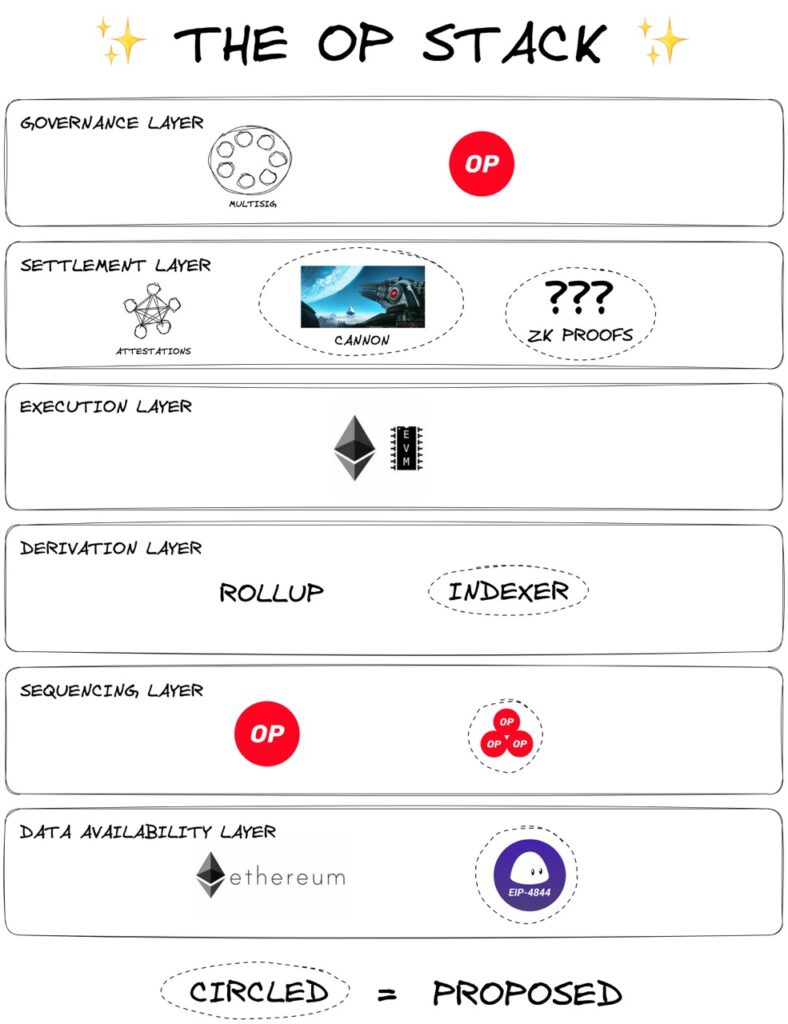
The Superchain’s architecture relies on a two-house governance system that balances operational agility with economic security. This structure is designed to align incentives across the federation, ensuring that sequencers, builders, and users share in the network’s growth rather than competing against it.
The Two-House System
Governance is split between an Operational House and a Security House. The Operational House handles routine upgrades, parameter tuning, and protocol improvements. It moves quickly to keep the stack competitive. The Security House holds veto power over changes that could compromise the integrity of the shared security model. This separation prevents any single entity from unilaterally altering the rules of the federation.
Shared Sequencer Fees
Sequencer fee sharing is a core mechanism for maintaining alignment. Instead of sequencers capturing all transaction fees, a portion is redistributed to the broader ecosystem. This model incentivizes sequencers to prioritize throughput and reliability over short-term extraction. It also funds the public goods that keep the Superchain attractive to developers and users.
Security as a Public Good
Shared security means that all OP Chains benefit from the same robust validation layer. This reduces the cost of launching new chains and ensures consistent security standards. As the network grows, the value of this shared security increases, creating a positive feedback loop for the entire ecosystem.
Superchain Architecture FAQs
The superchain model represents a shift from isolated Layer 2 chains to a coordinated network of networks. Below are the most common questions regarding its 2026 implementation, focusing on technical specifics and security.
How does the superchain differ from a single chain?
A superchain is not a single blockchain but an aggregation of multiple L2s sharing a common standard. Powered by the OP Stack, these chains share a unified sequencer and bridge infrastructure. This architecture reduces redundancy while allowing each chain to maintain its own state and governance. The result is a "network of networks" where liquidity and security are pooled across the ecosystem.
Is the OP Stack safe for production use?
Security relies on the underlying L1 (Ethereum) and the validity proofs generated by each L2. While the OP Stack is open-source and widely adopted, its safety depends on the specific configuration of each superchain. Users should verify that their chosen L2 has active fraud or validity proofs submitted to Ethereum. The shared infrastructure reduces individual operational risks but introduces cross-chain dependency concerns.
What are the risks of cross-chain messaging?
Superchains use a standardized messaging protocol (OP Messages) to transfer data and assets between chains. This introduces complexity: a vulnerability in the messaging bridge could affect multiple chains simultaneously. While the protocol is robust, users must remain aware that interoperability increases the attack surface. Always verify the specific bridge contract and monitor official security announcements from the superchain operators.
No comments yet. Be the first to share your thoughts!