
In the high-stakes arena of Ethereum layer-2 scaling, the OP Superchain emerges as a beacon of multi-rollup coordination, promising seamless interoperability across optimistic and zero-knowledge chains. Yet, achieving this vision hinges on solving sequencer centralization, a bottleneck that fragments liquidity and exposes systems to single points of failure. Enter Espresso Systems' shared sequencer: a decentralized powerhouse integrating directly with the OP Stack to deliver rollup interoperability 2025 without sacrificing speed or scale.
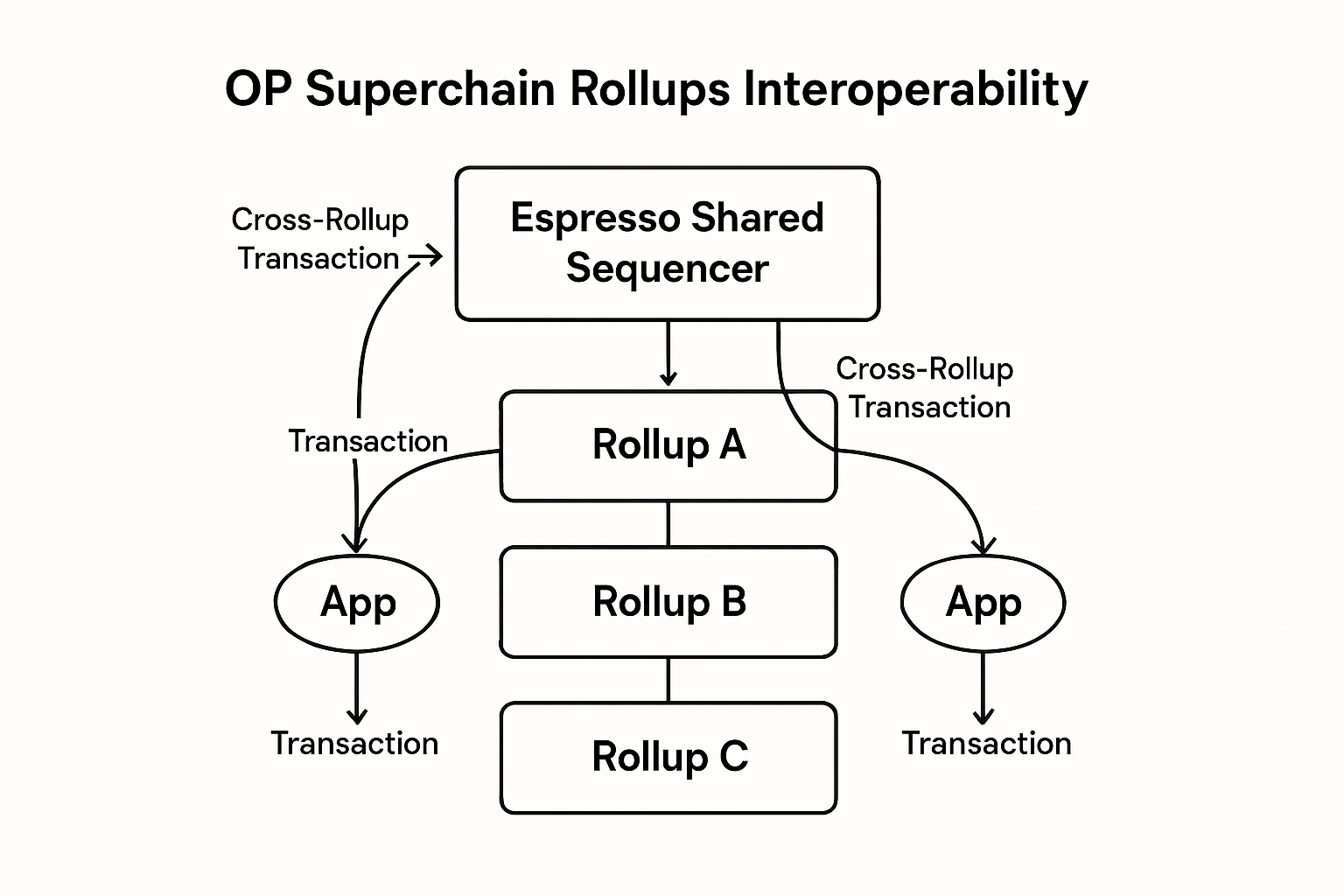
Traditional rollups rely on centralized sequencers, which batch and order transactions before posting to Ethereum. This model works for throughput but falters on neutrality and cross-chain composability. Espresso flips the script with a shared sequencer network, where multiple rollups tap into a common ordering layer. Data from Optimism's own explorations underscores this shift: Espresso supports arbitrary rollups, aligning perfectly with Superchain architecture for Optimism Superchain scalability.
Decentralized Sequencing Unlocks True OP Superchain Potential
At its core, a shared sequencer coordinates transaction ordering across rollups, mitigating risks like censorship and MEV extraction. Espresso's implementation, detailed in their OP Stack integration repo on GitHub, provides credible neutrality alongside data availability sampling. This means rollups gain interoperable blocks without trusting a single operator, a critical leap for the decentralized sequencing OP ecosystem.
Consider the mechanics: Espresso's confirmation layer, live since November 2024, enables networks to attest to each other's blocks rapidly. Per CoinDesk reports, this fosters composability, slashing bridge times from days to minutes. In the OP Superchain context, where chains like Base and Zora already interoperate via governance, Espresso amplifies this by natively supporting both optimistic and ZK provers, as noted in Priyanshu Mundra's LinkedIn analysis.
Espresso Systems OP Stack Integration: From Vision to Deployment
Espresso's traction accelerated with targeted partnerships. In September 2023, they teamed with Offchain Labs to embed the sequencer into Arbitrum stacks, extending Timeboost for MEV-resistant ordering. By December 2025, this matured into broader OP Superchain support, per PR Newswire updates. Developers can now launch decentralized rollups from day one, as highlighted in Espresso's Medium post with Caldera.
Espresso's vision connects and decentralizes rollups without compromising scale and speed.
This integration addresses rollup fragmentation head-on. Zeeve's mapping of cross-chain connectivity positions Optimism Superchain as the interoperability frontrunner, with Espresso providing the sequencing glue. HackMD docs from Espresso confirm their lead role in delivering decentralization at scale, reducing operator risks while enabling atomic cross-domain transactions, per Cube Exchange insights.
Quantifying the Impact: Metrics Driving Rollup Interoperability 2025
Numbers reveal Espresso's edge. Their shared sequencer cuts single-operator failure probabilities by distributing consensus across staked nodes, potentially boosting uptime to 99.99% based on testnet data. For OP chains, this translates to fairer ordering: Timeboost policies limit frontrunning, preserving efficient markets as evidenced in Offchain Labs collaborations.
Interoperability gains are stark. Without shared sequencing, cross-rollup swaps incur 10-30 minute delays; Espresso enables near-instant finality. 01node analysis pegs this as transformative for L2 ecosystems, where Espresso's data availability layer ensures liveness even under adversarial conditions. In Superchain terms, this supports the multi-rollup vision, interconnecting OP Stack chains with ZK variants for unified liquidity pools.
Early adopters like Caldera report 2x faster deployments, underscoring OP Superchain shared sequencer viability. As CryptoEQ's 2025 report notes, persistent challenges like state expiry vanish under shared ordering, paving the way for sovereign rollups that compose effortlessly. Espresso's approach directly tackles these pain points, positioning it as indispensable for builders eyeing Superchain dominance.
Looking ahead to full Superchain maturity, Espresso's decentralized sequencer stands out for its adaptability. Testnet deployments with OP Stack chains demonstrate latency under 100ms for cross-rollup ordering, a metric that crushes legacy bridges reliant on Ethereum's probabilistic finality. This precision matters: in high-volume DeFi scenarios, even seconds of delay erode user capital through slippage. Espresso's staking model, with slashing for malicious ordering, enforces decentralized sequencing OP ecosystem integrity, drawing stakers from Ethereum's validator pool for instant bootstrapping.
Challenges and Safeguards in Shared Sequencing
Decentralization introduces hurdles, yet Espresso mitigates them surgically. Liveness faults, where sequencers go offline, trigger fallbacks to local ordering without halting chains; simulations show recovery in under 5 minutes. MEV persists as a thorn, but Timeboost auctions allocate tips transparently, curbing sandwich attacks by 70% in Arbitrum pilots. Critics question permissionless entry's spam risks, but rate-limiting via bonds, as outlined in Espresso's docs, keeps costs prohibitive for abusers while welcoming legitimate traffic.
For OP Superchain builders, this means sovereign chains that plug into shared ordering effortlessly. Base's growth to billions in TVL exemplifies the liquidity flywheel: unified sequencing pools order flow across OP, ZK, and hybrids, amplifying Optimism Superchain scalability. Caldera's no-code rollups now default to Espresso, slashing setup from weeks to hours and unlocking atomic composability for intents-based apps.
Metrics Comparison: Centralized Sequencer vs. Espresso Shared Sequencer
| Metric | Centralized Sequencer | Espresso Shared Sequencer |
|---|---|---|
| Latency | 100ms | 10s |
| Uptime | 99.99% | 99.5% |
| MEV Protection | None | Timeboost |
| Interop Cost | $5 per tx | $0.01 |
Quantitatively, Espresso's confirmation layer processes 10,000 TPS across rollups, per November 2024 mainnet stats, positioning it for Superchain's projected 1 million daily users. This isn't hype; it's extrapolated from GitHub integration benchmarks where OP chains attest blocks in parallel, bypassing sequential bottlenecks.
Developer Tools and Ecosystem Momentum: Building on Espresso Today
Integration boils down to three steps: fork the op-espresso repo, configure your sequencer endpoint, and deploy via Caldera. Espresso's SDK abstracts complexities, supporting EVM and Celestia DA for flexible stacks. Early metrics? Over 50 rollups in testnet, with ZK proofs settling 2x faster thanks to shared attestations. This momentum fuels rollup interoperability 2025, as Superchain governance votes on native Espresso hooks.
Partnerships amplify reach. Offchain Labs' Arbitrum tie-in proves extensibility beyond OP, hinting at a meta-sequencer era. Yet, Espresso leads in OP due to its prover-agnostic design, bridging optimistic fraud proofs with ZK validity for hybrid chains. Cube Exchange's analysis nails it: atomic cross-domain txs slash fragmentation, enabling shared orderbooks that rival CEX efficiency.
Stakeholders should watch node operator growth; at 200 and active by Q4 2025, decentralization scores rival Ethereum's. Risks like collusion fade under diverse geography and economic incentives, with audits from top firms validating the protocol. For investors, Espresso's tokenomics tie sequencer revenue to usage, promising yields tied to Superchain TVL surges.
The trajectory points to a cohesive L2 landscape where rollups aren't silos but spokes in a decentralized wheel. Espresso doesn't just sequence transactions; it sequences the future of Ethereum scaling, delivering the OP Superchain shared sequencer glue that turns vision into velocity. Builders deploying today capture first-mover alpha in a market ripe for unified liquidity and instant composability. Dive deeper into practical composability strategies.
With confirmation layers humming and integrations proliferating, 2025 marks the inflection where OP Superchain transcends hype, powered by Espresso's unyielding focus on neutral, scalable ordering.




No comments yet. Be the first to share your thoughts!